
Bottoms Industry Trends and Sourcing Report
For sourcing managers and brands in Europe and North America
1. Industry Trends: Size and What Is Driving Growth
Bottoms are one of the largest and most stable apparel categories in the world. By different scopes, the global denim market was worth about USD 71.1 billion in 2024, projected to reach USD 119.5 billion by 2032 (CAGR ~6.7%); the denim jeans market was about USD 86.7 billion in 2024, growing at ~5.9% CAGR from 2025 to 2030. The women’s trousers market was about USD 245.7 billion in 2025, heading toward USD 322.3 billion by 2031 (CAGR ~4.6%). Meanwhile, wide-leg cargo trousers—about USD 2.3 billion in 2025—are expanding at roughly 8.0% a year through 2034. The category is stable; profit is migrating to segmentation and finishing capability.
Three trends are reshaping the category:
1) Sustainability is now a hard constraint. Global fiber production reached about 132 million tonnes in 2024, with polyester at roughly 59% (about 88% of it fossil-based) and cotton at about 19%. Recycled polyester rose from 8.9 to about 9.3 million tonnes, yet its share of all polyester fell from 12.5% to about 12%, because virgin polyester grew faster. In plain terms: sustainable material is growing but being diluted by cheaper virgin synthetics. Relying on “recycled polyester” alone no longer differentiates a brand—buyers now look at certifications (GRS, OEKO-TEX) and traceability.
2) Comfort and function are the new baseline. Roughly 40% of custom pants now integrate stretch fabrics. Nike’s 24.7 line uses four-way-stretch polyester; Levi’s Tech Series markets a stretch, moisture-wicking chino. Stretch, moisture management and wrinkle resistance—the “invisible” processes—now drive repeat purchase.
3) Utility and wider fits are back. Wide-leg, cargo and utilitarian styles are strengthening across Europe and North America—the market asking for one pair of trousers that works across commute, outdoors and home.
2. Fabric Selection: Evaluation and Trade-offs
Fabric selection comes down to three balances: durability vs. comfort, cost vs. certification, and hand-feel vs. function.
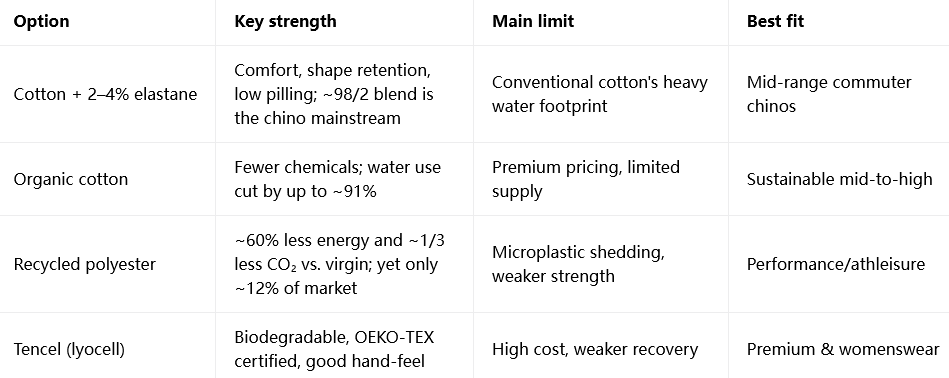
Bottom line for volume EU/US trousers: a cotton/recycled-cotton + elastane blend remains the best intersection of price, performance and consumer acceptance. Deploying organic cotton or recycled polyester as a certification point rather than a whole-range replacement is the cost-controlled path to a credible sustainability story.
3. Sourcing Implications
- Segment your fabric bill. Commuter chinos: cotton + 2–4% elastane; performance lines: recycled polyester + Tencel; sustainability claims: certified cotton as a selective point.
- Verify certifications, not labels. Run due diligence on GRS/OEKO-TEX claims and request traceable records of fiber content.
- Don’t pay a whole-range premium for sustainability. Use recycled and organic materials as differentiated endorsements; use blends for volume base.